ESG Disclosure
Sound ESG management requires not only establishing an ESG framework but also ensuring robust ESG disclosure.
Investors make decisions based on external assessments of companies’ ESG performance, and such investment behavior contributes to a virtuous cycle in which strong ESG practices ultimately lead to improved financial performance.
Key Global Trends in Sustainability Reporting
Leading global companies have steadily increased the rate at which they publish sustainability reports.
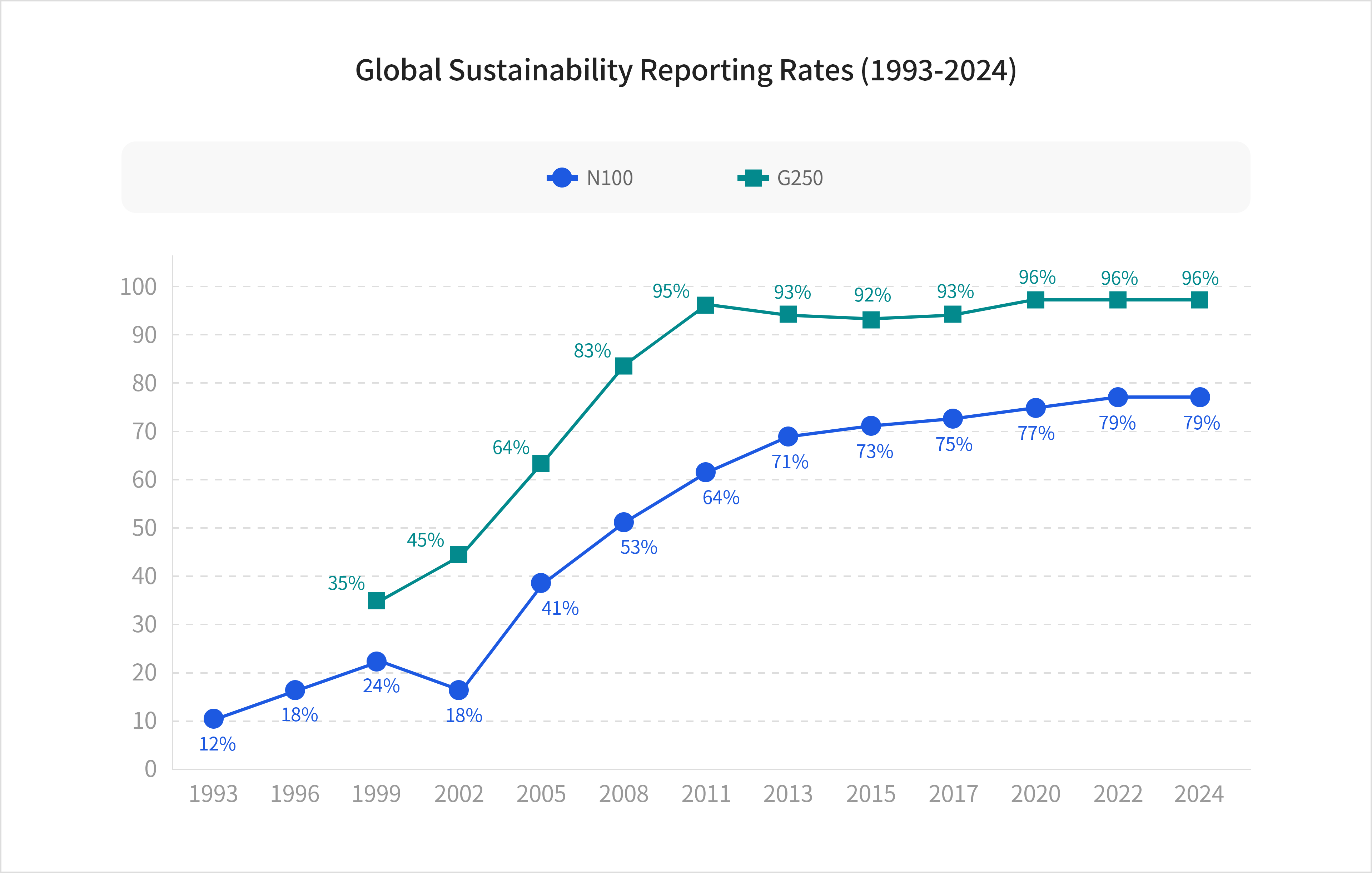
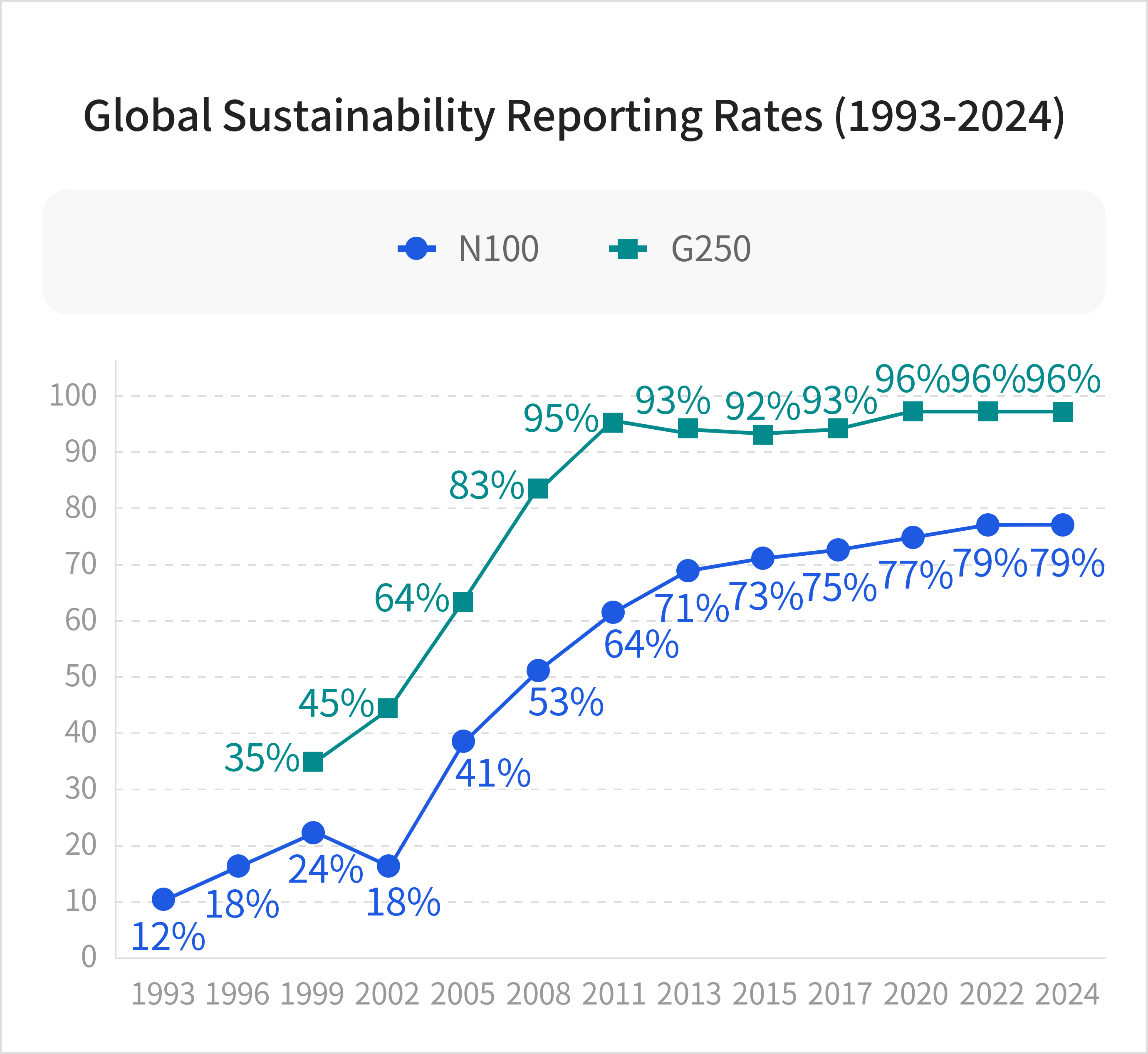
According to KPMG’s 2024 survey on global Sustainability Reporting trends, 79% of N100 companies (a total of 5,800 firms) and 96% of G250 companies (a total of 250 firms) publish sustainability reports.

N100 comprises the top 100 companies by revenue in 58 countries, selected by KPMG experts. G250 refers to the top 250 companies by revenue among the Fortune Global 500 companies in 2023.
Global Sustainability Reporting Rates (1993-2024)
							N100 : 1993. 12%, 1996. 18%, 1999. 24%, 2002. 18%, 2005. 41%, 2008. 53%, 2011. 64%, 2013. 71%, 2015. 74%, 2017. 75%, 2020. 77%, 2022. 79%, 2024. 79%
							G250: 1999. 35%, 2002. 45%, 2005. 64%, 2008. 83%, 2011. 95%, 2013. 93%, 2015. 92%, 2017. 93%, 2020. 96%, 2022. 96%, 2024. 96% Global Sustainability Reporting Rates (1993-2024)
							N100 : 1993. 12%, 1996. 18%, 1999. 24%, 2002. 18%, 2005. 41%, 2008. 53%, 2011. 64%, 2013. 71%, 2015. 74%, 2017. 75%, 2020. 77%, 2022. 79%, 2024. 79%
							G250: 1999. 35%, 2002. 45%, 2005. 64%, 2008. 83%, 2011. 95%, 2013. 93%, 2015. 92%, 2017. 93%, 2020. 96%, 2022. 96%, 2024. 96% Global Sustainability Reporting Rates (1993-2024)
							N100 : 1993. 12%, 1996. 18%, 1999. 24%, 2002. 18%, 2005. 41%, 2008. 53%, 2011. 64%, 2013. 71%, 2015. 74%, 2017. 75%, 2020. 77%, 2022. 79%, 2024. 79%
							G250: 1999. 35%, 2002. 45%, 2005. 64%, 2008. 83%, 2011. 95%, 2013. 93%, 2015. 92%, 2017. 93%, 2020. 96%, 2022. 96%, 2024. 96%
Source: KPMG
Domestic companies are increasingly recognizing the importance of ESG disclosure and are publishing separate ESG reports to strengthen their ESG management practices.
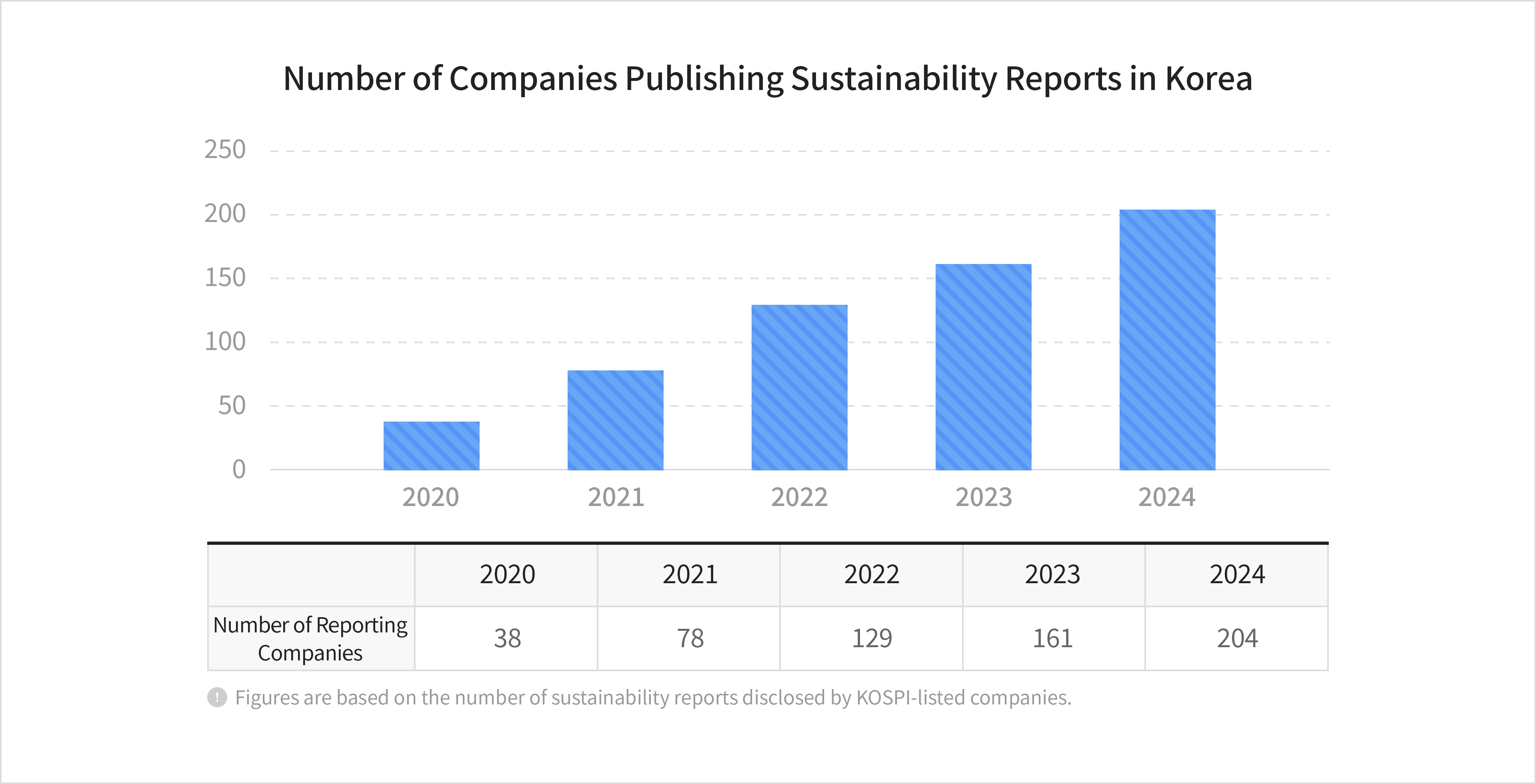
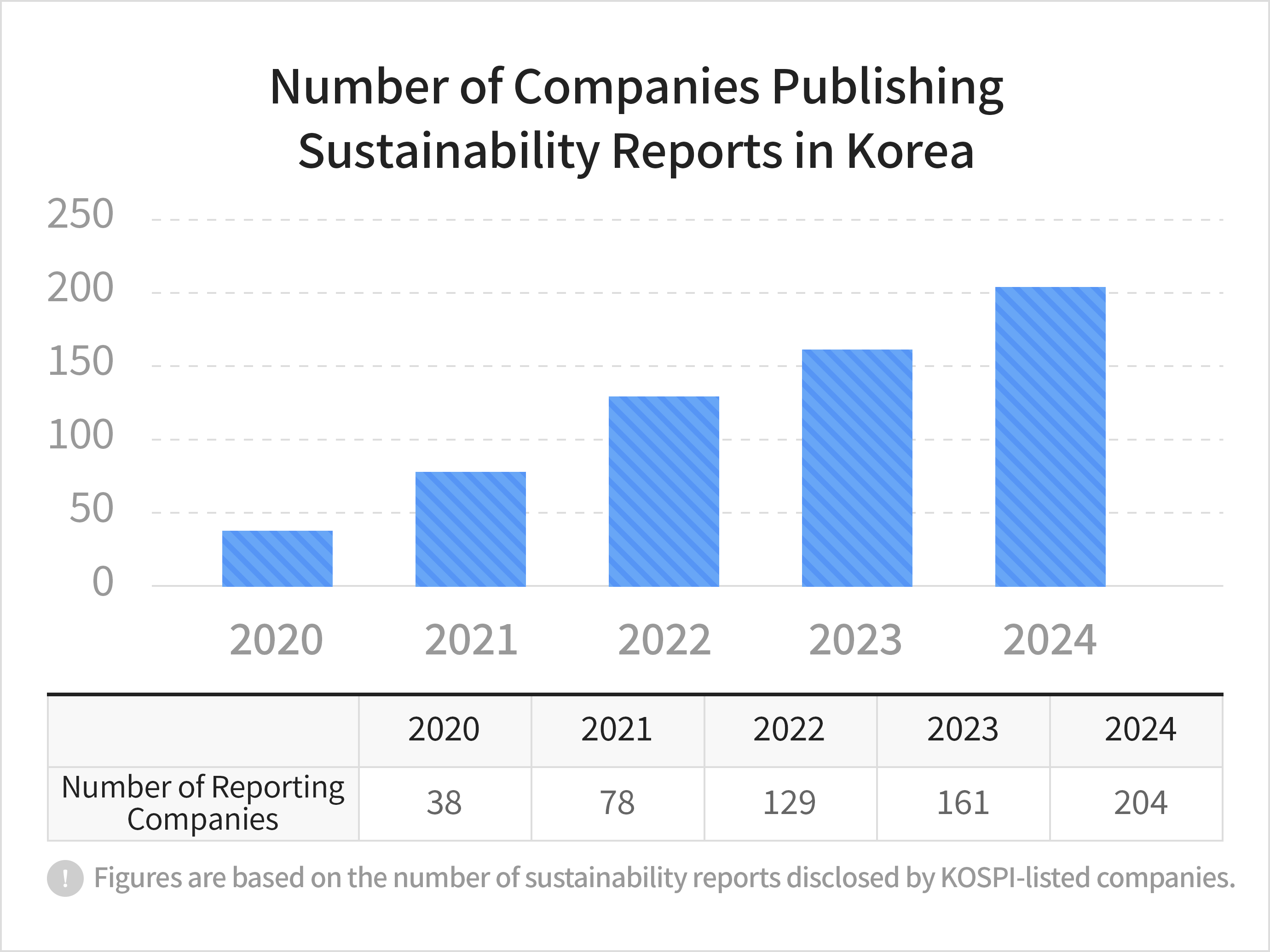
Over the past five years, the number of KOSPI-listed companies voluntarily issuing sustainability reports has continued to grow. Although sustainability reporting is not mandatory, an increasing number of companies voluntarily disclose ESG-related information each year to provide investors with insight into their ESG practices.
Number of Companies Publishing Sustainability Reports in Korea
							Number of Reporting Companies
							2020 : 38, 2021 : 78, 2022 : 129, 2023 : 161, 2024 : 204
							Figures are based on the number of sustainability reports disclosed by KOSPI-listed companies. Number of Companies Publishing Sustainability Reports in Korea
							Number of Reporting Companies
							2020 : 38, 2021 : 78, 2022 : 129, 2023 : 161, 2024 : 204
							Figures are based on the number of sustainability reports disclosed by KOSPI-listed companies. Number of Companies Publishing Sustainability Reports in Korea
							Number of Reporting Companies
							2020 : 38, 2021 : 78, 2022 : 129, 2023 : 161, 2024 : 204
							Figures are based on the number of sustainability reports disclosed by KOSPI-listed companies.
ESG Reporting Standards
Companies in Korea and around the world prepare ESG reports using various global disclosure standards, including GRI, SASB, and TCFD. In addition, jurisdictions such as Korea, the European Union, the United States, Japan, and Australia are actively developing their own sustainability disclosure frameworks.
Guidelines. 1989 : Ceres Principles released, 1999 : First draft of GRI Guidelines released (2002: G2, 2006: G3, 2013: G4, 2016: SRS, 2021: latest version), 2000 : CDP Reporting Framework introduced, 2011 : UN Guiding Principles on Business and Human Rights (UNGPs) issued, 2013 : IIRC Integrated Reporting Framework released, 2017 : TCFD launched, 2018 : SASB Standards released,  2021 : Korea introduces revised ESG disclosure plan, U.S. SEC proposes mandatory climate-related disclosures, 2023 : ISSB, ESRS, and TNFD frameworks released
							Background. 1989 : Exxon Valdez oil spill, Ceres established, 1997 : GRI established UNEP+Ceres+Telus, 2000 : CDP founded, 2001/2003 : EU 2001 Sustainable Development Strategy announced EU 2003 Accounting Modernization Directive (2003/51/EC) adopted, 2003 : France enacts law on non-financial reporting for large companies, 2006 : UN PRI launched, UK enacts law on reporting of environment, labor, and society, 2007 : Sweden mandates sustainability reporting for state-owned companies, 2008 : Denmark enacts law on non-financial reporting for large companies, 2010 : IIRC established, 2011 : SASB established, 2014 : EU NFRD adopted, 2015 : Paris Agreement signed, SBTi formed, 2019 : EU Green Deal announced, 2020 : Korea’s National Pension Service (NPS) announces expansion of ESG investment, 2020 : EU proposes Corporate Sustainability Due Diligence Directive (CSDDD)
							Although many more ESG-related guidelines exist, the above list highlights those with the most significant impact on companies. Guidelines. 1989 : Ceres Principles released, 1999 : First draft of GRI Guidelines released (2002: G2, 2006: G3, 2013: G4, 2016: SRS, 2021: latest version), 2000 : CDP Reporting Framework introduced, 2011 : UN Guiding Principles on Business and Human Rights (UNGPs) issued, 2013 : IIRC Integrated Reporting Framework released, 2017 : TCFD launched, 2018 : SASB Standards released,  2021 : Korea introduces revised ESG disclosure plan, U.S. SEC proposes mandatory climate-related disclosures, 2023 : ISSB, ESRS, and TNFD frameworks released
							Background. 1989 : Exxon Valdez oil spill, Ceres established, 1997 : GRI established UNEP+Ceres+Telus, 2000 : CDP founded, 2001/2003 : EU 2001 Sustainable Development Strategy announced EU 2003 Accounting Modernization Directive (2003/51/EC) adopted, 2003 : France enacts law on non-financial reporting for large companies, 2006 : UN PRI launched, UK enacts law on reporting of environment, labor, and society, 2007 : Sweden mandates sustainability reporting for state-owned companies, 2008 : Denmark enacts law on non-financial reporting for large companies, 2010 : IIRC established, 2011 : SASB established, 2014 : EU NFRD adopted, 2015 : Paris Agreement signed, SBTi formed, 2019 : EU Green Deal announced, 2020 : Korea’s National Pension Service (NPS) announces expansion of ESG investment, 2020 : EU proposes Corporate Sustainability Due Diligence Directive (CSDDD)
							Although many more ESG-related guidelines exist, the above list highlights those with the most significant impact on companies. Guidelines. 1989 : Ceres Principles released, 1999 : First draft of GRI Guidelines released (2002: G2, 2006: G3, 2013: G4, 2016: SRS, 2021: latest version), 2000 : CDP Reporting Framework introduced, 2011 : UN Guiding Principles on Business and Human Rights (UNGPs) issued, 2013 : IIRC Integrated Reporting Framework released, 2017 : TCFD launched, 2018 : SASB Standards released,  2021 : Korea introduces revised ESG disclosure plan, U.S. SEC proposes mandatory climate-related disclosures, 2023 : ISSB, ESRS, and TNFD frameworks released
							Background. 1989 : Exxon Valdez oil spill, Ceres established, 1997 : GRI established UNEP+Ceres+Telus, 2000 : CDP founded, 2001/2003 : EU 2001 Sustainable Development Strategy announced EU 2003 Accounting Modernization Directive (2003/51/EC) adopted, 2003 : France enacts law on non-financial reporting for large companies, 2006 : UN PRI launched, UK enacts law on reporting of environment, labor, and society, 2007 : Sweden mandates sustainability reporting for state-owned companies, 2008 : Denmark enacts law on non-financial reporting for large companies, 2010 : IIRC established, 2011 : SASB established, 2014 : EU NFRD adopted, 2015 : Paris Agreement signed, SBTi formed, 2019 : EU Green Deal announced, 2020 : Korea’s National Pension Service (NPS) announces expansion of ESG investment, 2020 : EU proposes Corporate Sustainability Due Diligence Directive (CSDDD)
							Although many more ESG-related guidelines exist, the above list highlights those with the most significant impact on companies.
Source: Center for Social value Enhancement Studies(CSES)
Key Global Standards in ESG Reporting
Standards Key Characteristics
IFRS S1, S2 - Sustainability disclosure standards issued by the ISSB (International Sustainability Standards Board) under the IFRS Foundation.
- IFRS S1 sets out general requirements for sustainability-related disclosures useful to investors, while IFRS S2 provides specific requirements for climate-related disclosures.
GRI Standards - The world’s first sustainability reporting standards.
- Comprised of Universal Standards, Sector Standards, and Topic Standards.
TCFD Recommendations - A framework for climate-related financial disclosures.
- Structured around four thematic areas: Governance, Strategy, Risk Management, and Metrics & Targets.
SASB Standards - Industry-specific standards focused on sustainability issues most likely to have a material financial impact.
- Cover 77 industries across 11 sectors, each with tailored ESG disclosure metrics.