ESG History
How ESG Emerged
ESG may feel like a newly emerging buzzword, but it is not unfamiliar. The concept originates from sustainable development—meeting today’s needs while protecting the future for the next generation. Building on this idea, ESG frames corporate sustainability and long-term growth around three core values: environment, society, and governance.
Sustainable Management
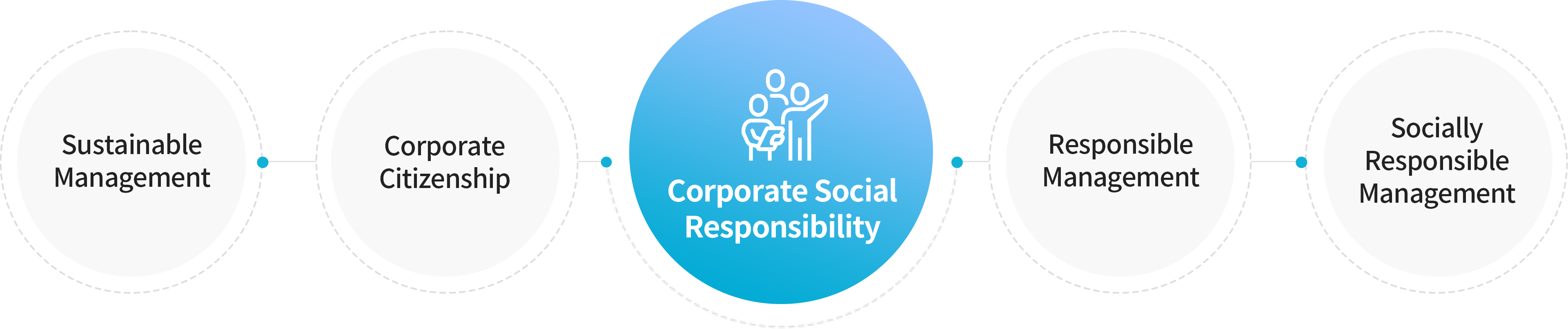
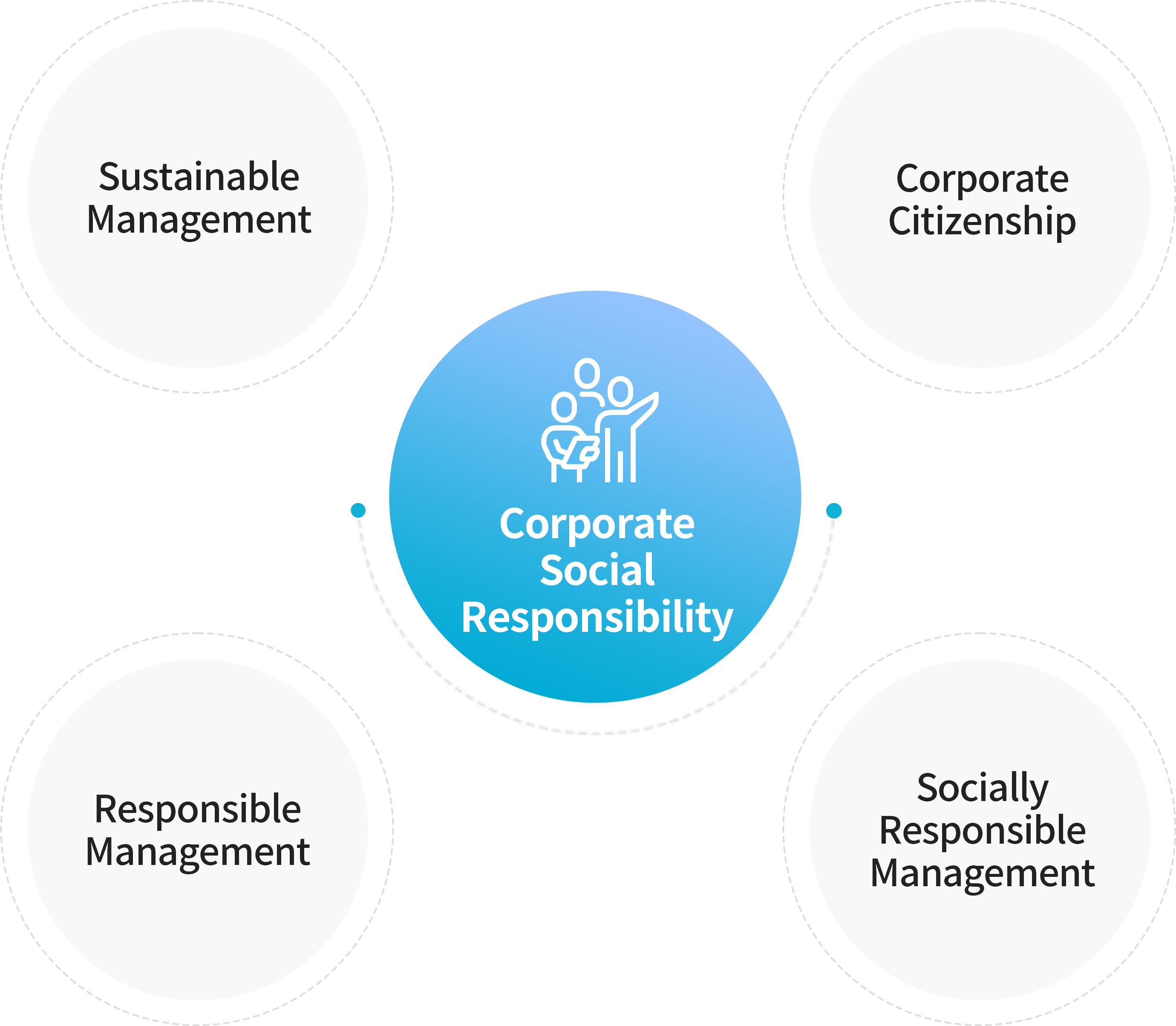
(Sustainable Management, Corporate Citizenship, Corporate Social Responsibility, Responsible Management, Socially Responsible Management) (Sustainable Management, Corporate Citizenship, Corporate Social Responsibility, Responsible Management, Socially Responsible Management) (Sustainable Management, Corporate Citizenship, Corporate Social Responsibility, Responsible Management, Socially Responsible Management)
Sustainability
Improving the quality of human life while living within the carrying capacity of supporting eco-systems (1991, UNEP, Caring for the Earth : A strategy for Sustainable Living)
Sustainable Development
Meets the needs of the present without compromising the ability of future generations to meet their own needs (1987, WCED, Our Common Future)
Sustainable Management
A business paradigm that pursues sustainable development based on an organization’s economic, social, and environmental responsibilities
Sustainable management represents a more fundamental concept than ESG. Today, ESG can be understood as the evolution and institutionalization of sustainable management and corporate social responsibility (CSR). As expectations for the relationship between business and society have shifted over time, a deeper understanding of sustainable management helps make ESG more widely applicable. The term “sustainability” was first introduced in 1713, and the most widely accepted concept was established in the 1987 report Our Common Future. Later, the introduction of CSR and the concept of Creating Shared Value (CSV) shaped ESG into a new paradigm.
A Brief History of Sustainable Management
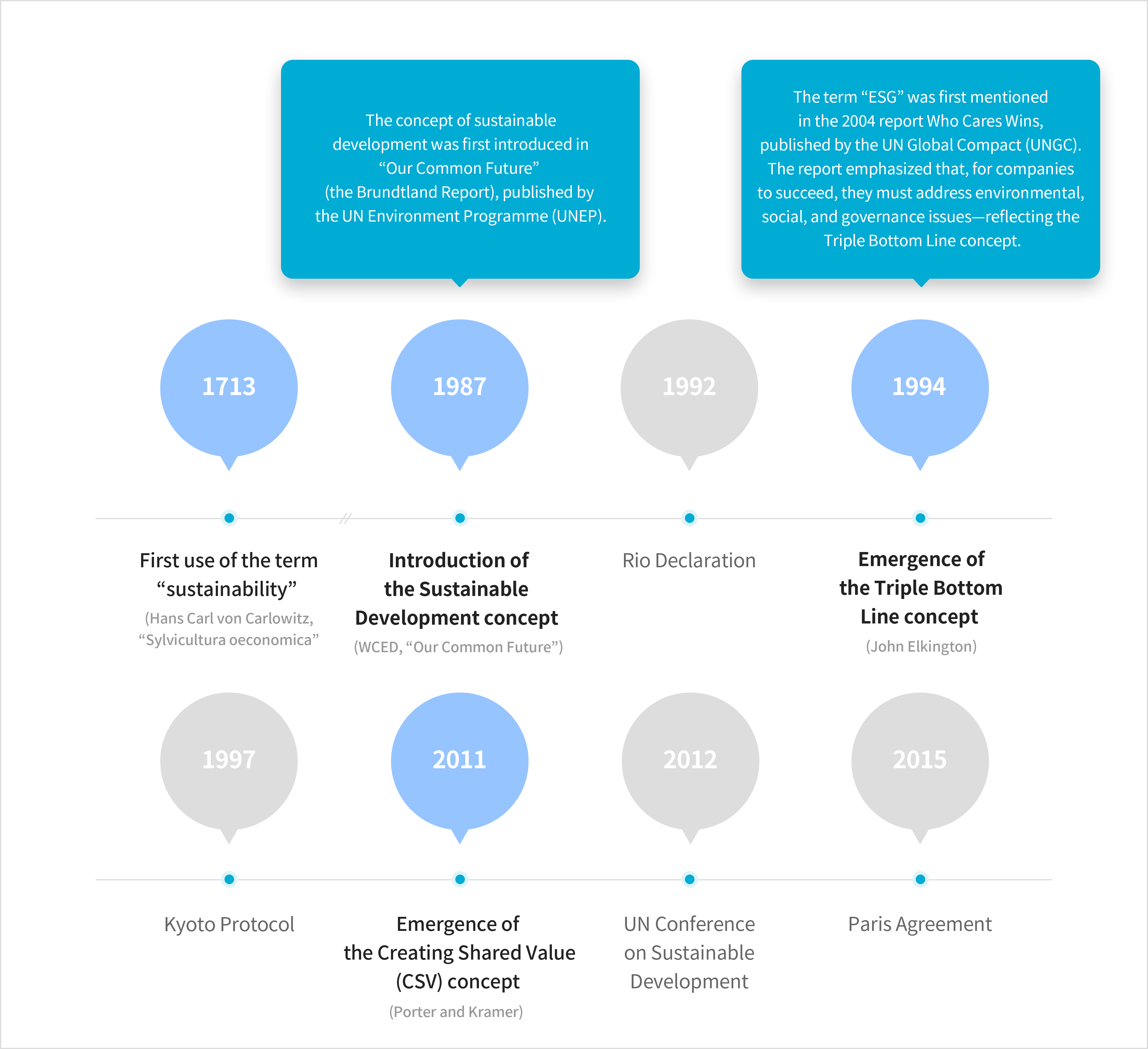
1713 : First use of the term “sustainability” (Hans Carl von Carlowitz, “Sylvicultura oeconomica”)
							1987 : Introduction of the Sustainable Development concept (WCED, “Our Common Future”) The concept of sustainable development was first introduced in “Our Common Future” (the Brundtland Report), published by the UN Environment Programme (UNEP).
							1992 : Rio Declaration
							1994 : Emergence of the Triple Bottom Line concept (John Elkington) The term “ESG” was first mentioned in the 2004 report Who Cares Wins, published by the UN Global Compact (UNGC). The report emphasized that, for companies to succeed, they must address environmental, social, and governance issues—reflecting the Triple Bottom Line concept.
							1997 : Kyoto Protocol
							2011 : Emergence of the Creating Shared Value (CSV) concept (Porter and Kramer)
							2012 : UN Conference on Sustainable Development
							2015 : Paris Agreement 1713 : First use of the term “sustainability” (Hans Carl von Carlowitz, “Sylvicultura oeconomica”)
							1987 : Introduction of the Sustainable Development concept (WCED, “Our Common Future”) The concept of sustainable development was first introduced in “Our Common Future” (the Brundtland Report), published by the UN Environment Programme (UNEP).
							1992 : Rio Declaration
							1994 : Emergence of the Triple Bottom Line concept (John Elkington) The term “ESG” was first mentioned in the 2004 report Who Cares Wins, published by the UN Global Compact (UNGC). The report emphasized that, for companies to succeed, they must address environmental, social, and governance issues—reflecting the Triple Bottom Line concept.
							1997 : Kyoto Protocol
							2011 : Emergence of the Creating Shared Value (CSV) concept (Porter and Kramer)
							2012 : UN Conference on Sustainable Development
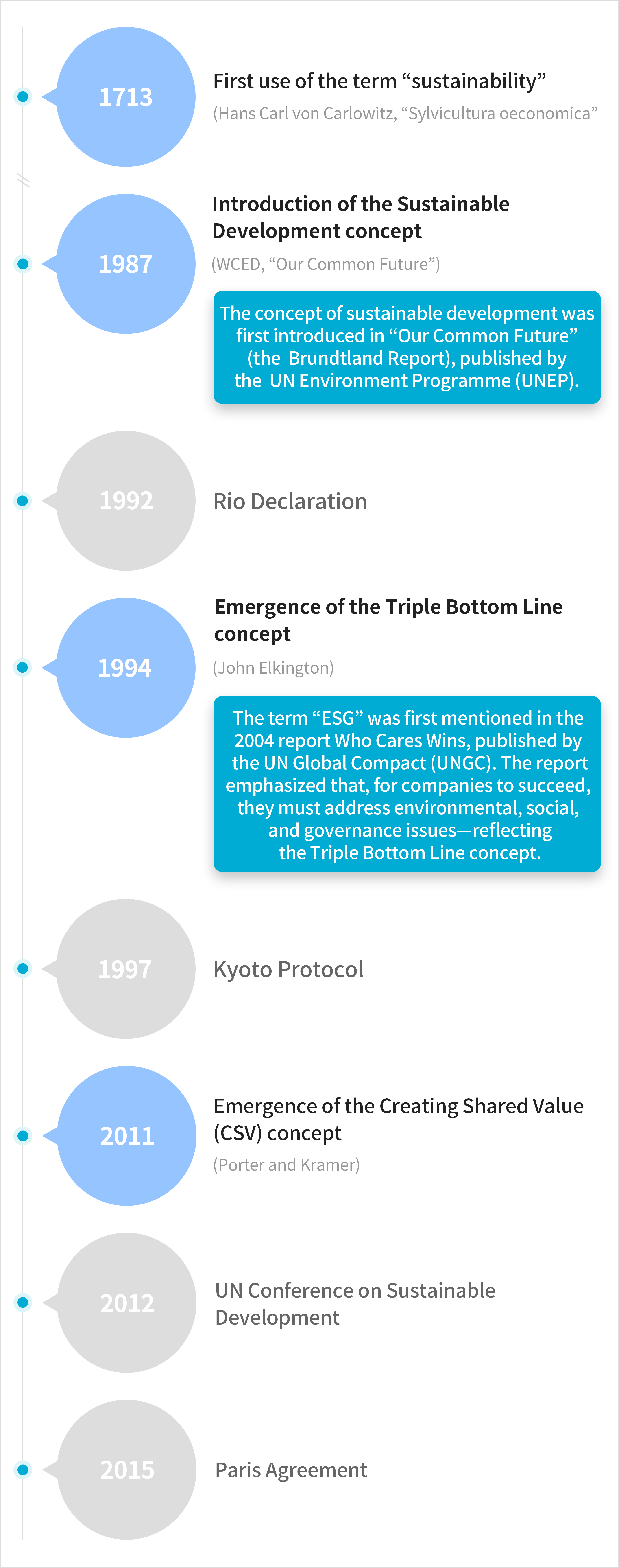
							2015 : Paris Agreement 1713 : First use of the term “sustainability” (Hans Carl von Carlowitz, “Sylvicultura oeconomica”)
							1987 : Introduction of the Sustainable Development concept (WCED, “Our Common Future”) The concept of sustainable development was first introduced in “Our Common Future” (the Brundtland Report), published by the UN Environment Programme (UNEP).
							1992 : Rio Declaration
							1994 : Emergence of the Triple Bottom Line concept (John Elkington) The term “ESG” was first mentioned in the 2004 report Who Cares Wins, published by the UN Global Compact (UNGC). The report emphasized that, for companies to succeed, they must address environmental, social, and governance issues—reflecting the Triple Bottom Line concept.
							1997 : Kyoto Protocol
							2011 : Emergence of the Creating Shared Value (CSV) concept (Porter and Kramer)
							2012 : UN Conference on Sustainable Development
							2015 : Paris Agreement
The term “ESG” was first officially used in the 2004 report Who Cares Wins, published by the UN Global Compact (UNGC). Subsequently, in 2006, the Principles for Responsible Investment (UN PRI), an alliance of international investors, emphasized ESG as an investment principle, laying the foundation for the ESG framework that is central to today’s corporate management. With the emergence of Capitalism 4.0 and stakeholder capitalism discourses, the COVID-19 pandemic accelerated global attention to ESG issues such as climate change, public health, and environmental protection. In line with this trend, ESG investing—actively incorporating ESG information into long-term investment decisions—has entered the mainstream.
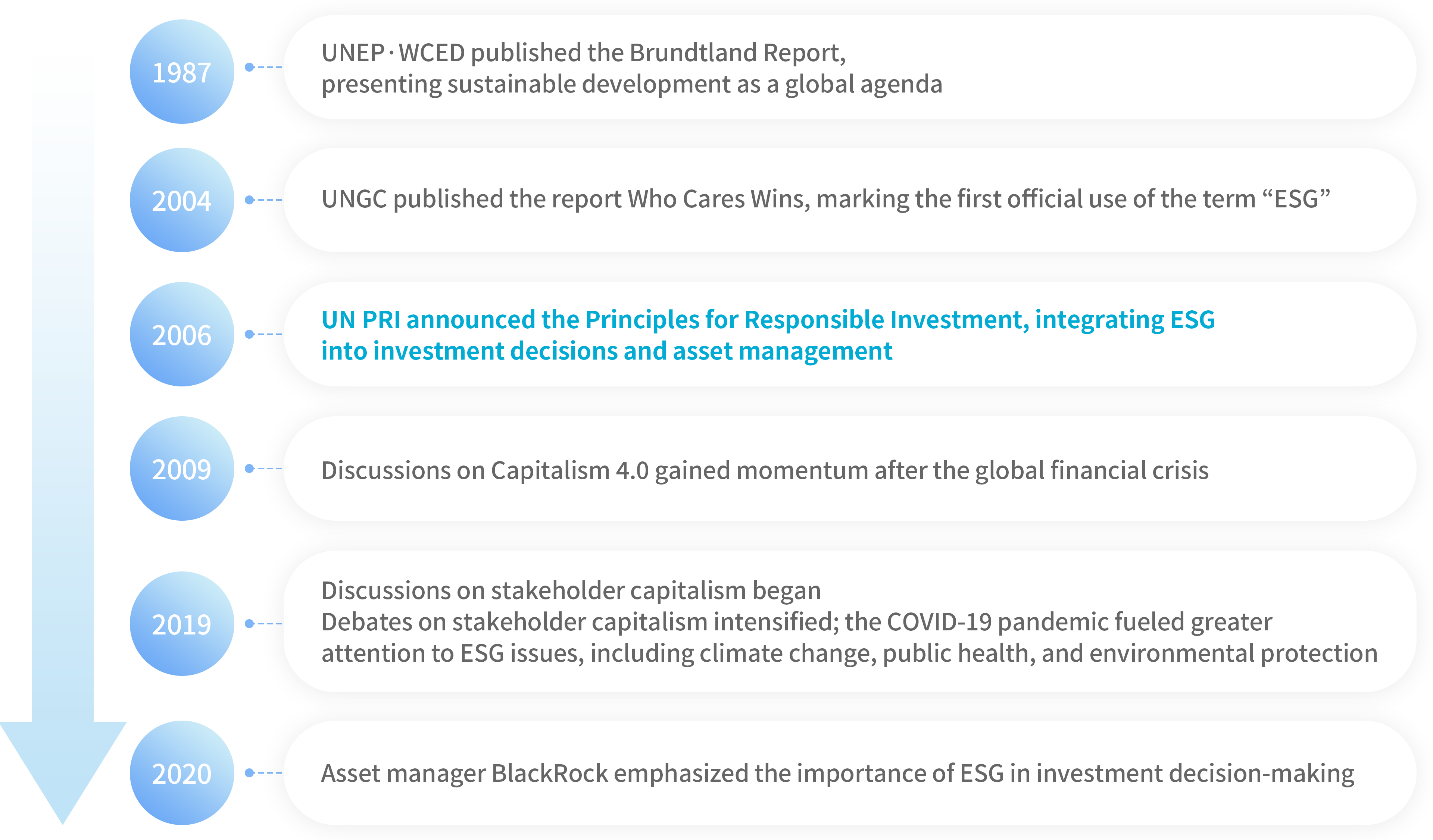
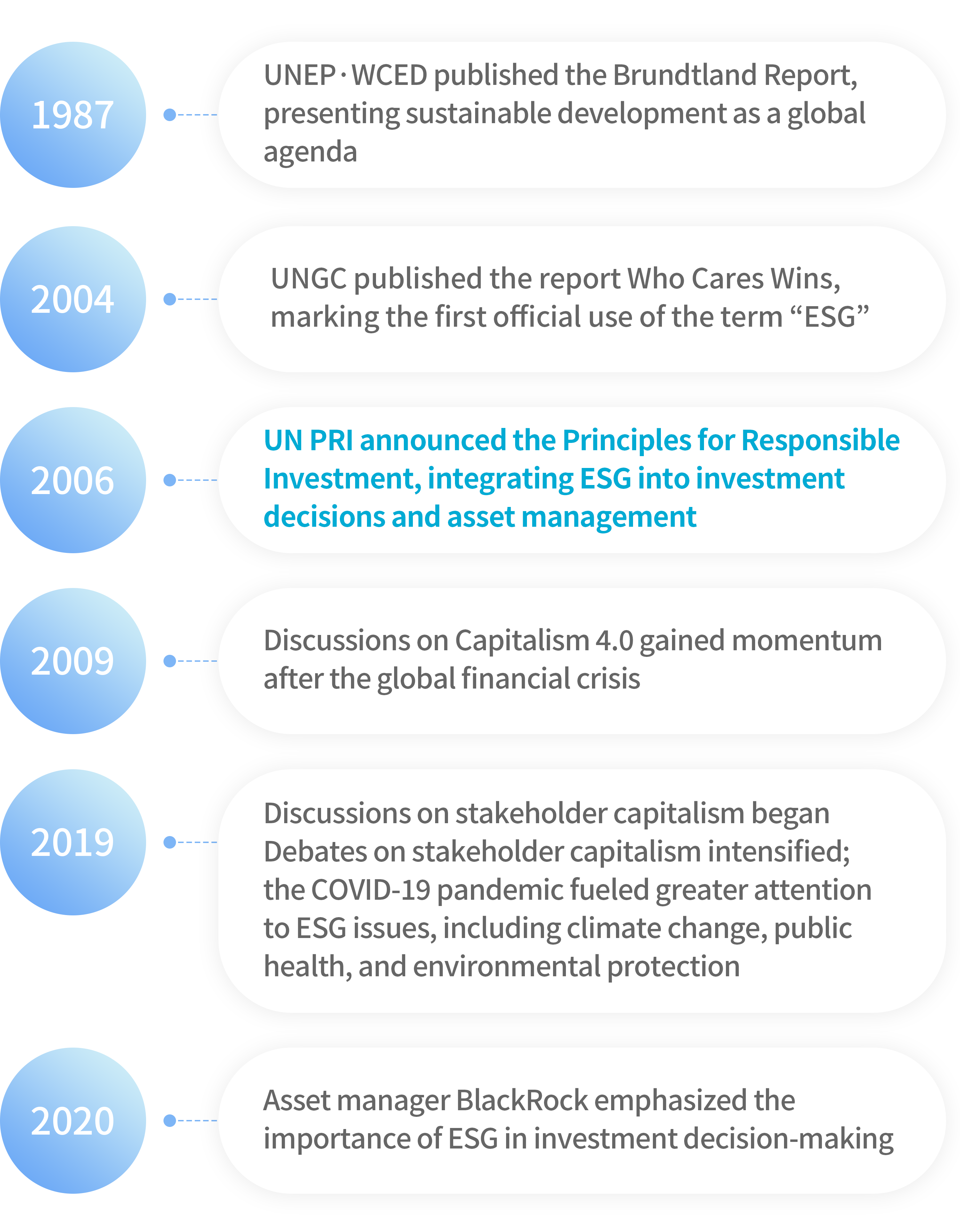
1987 : UNEP·WCED published the Brundtland Report, presenting sustainable development as a global agenda
							2004 : UNGC published the report Who Cares Wins, marking the first official use of the term “ESG”
							2006 : UN PRI announced the Principles for Responsible Investment, integrating ESG into investment decisions and asset management
							2009 : Discussions on Capitalism 4.0 gained momentum after the global financial crisis
							2019 : Discussions on stakeholder capitalism began Debates on stakeholder capitalism intensified; the COVID-19 pandemic fueled greater attention to ESG issues, including climate change, public health, and environmental protection
							2020 : Asset manager BlackRock emphasized the importance of ESG in investment decision-making 1987 : UNEP·WCED published the Brundtland Report, presenting sustainable development as a global agenda
							2004 : UNGC published the report Who Cares Wins, marking the first official use of the term “ESG”
							2006 : UN PRI announced the Principles for Responsible Investment, integrating ESG into investment decisions and asset management
							2009 : Discussions on Capitalism 4.0 gained momentum after the global financial crisis
							2019 : Discussions on stakeholder capitalism began Debates on stakeholder capitalism intensified; the COVID-19 pandemic fueled greater attention to ESG issues, including climate change, public health, and environmental protection
							2020 : Asset manager BlackRock emphasized the importance of ESG in investment decision-making 1987 : UNEP·WCED published the Brundtland Report, presenting sustainable development as a global agenda
							2004 : UNGC published the report Who Cares Wins, marking the first official use of the term “ESG”
							2006 : UN PRI announced the Principles for Responsible Investment, integrating ESG into investment decisions and asset management
							2009 : Discussions on Capitalism 4.0 gained momentum after the global financial crisis
							2019 : Discussions on stakeholder capitalism began Debates on stakeholder capitalism intensified; the COVID-19 pandemic fueled greater attention to ESG issues, including climate change, public health, and environmental protection
							2020 : Asset manager BlackRock emphasized the importance of ESG in investment decision-making