ESG Impact
2
We now live in an era where ESG considerations shape decision-making across sectors.
Individual Investors’ ESG Considerations
According to a 2025 Morgan Stanley survey of 1,765 individual investors, 88% of global respondents expressed interest in sustainable investing.
High-net-worth individuals—those with more than $100,000 in investable assets—showed even stronger interest compared to the general investor population.
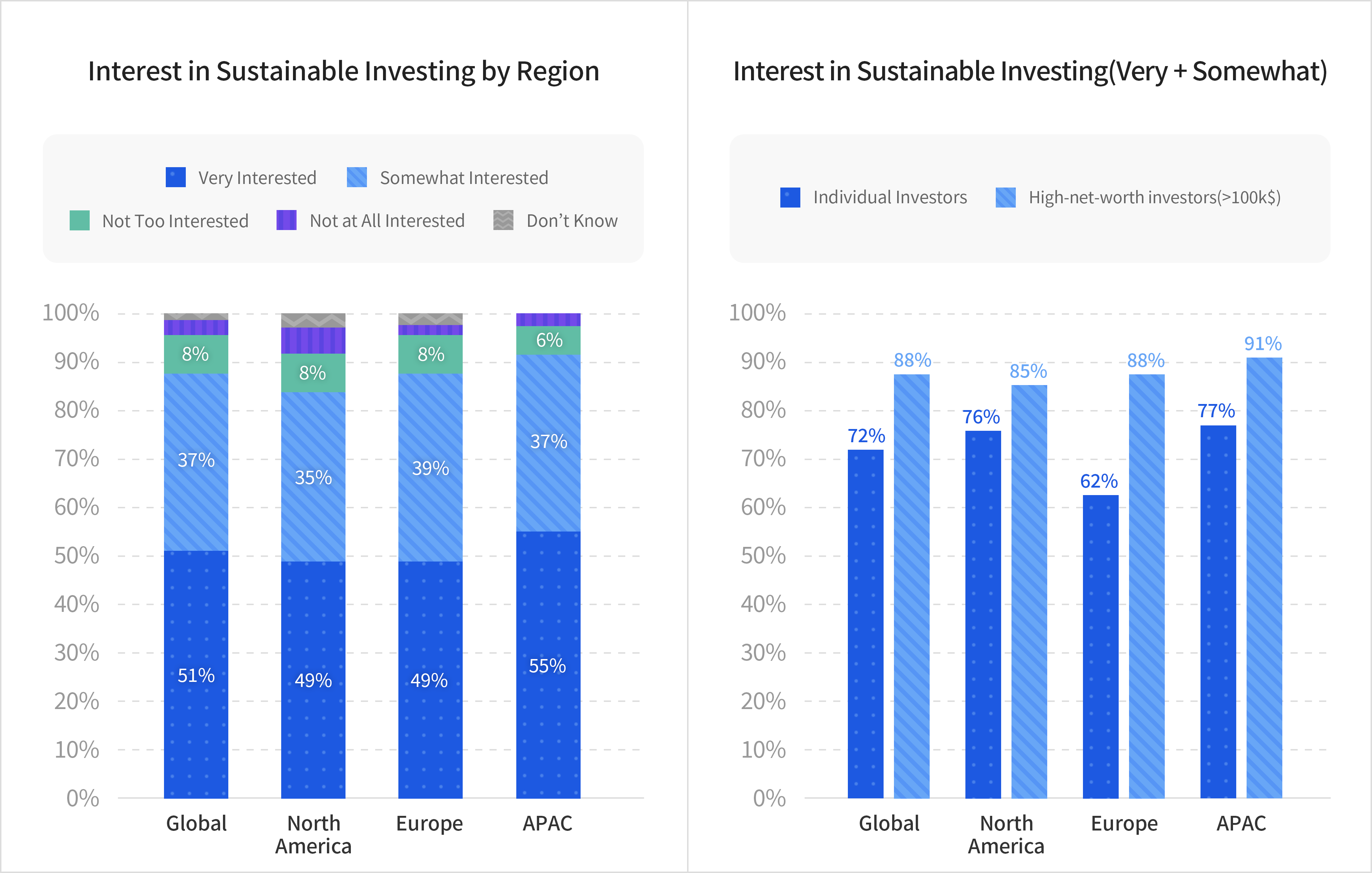
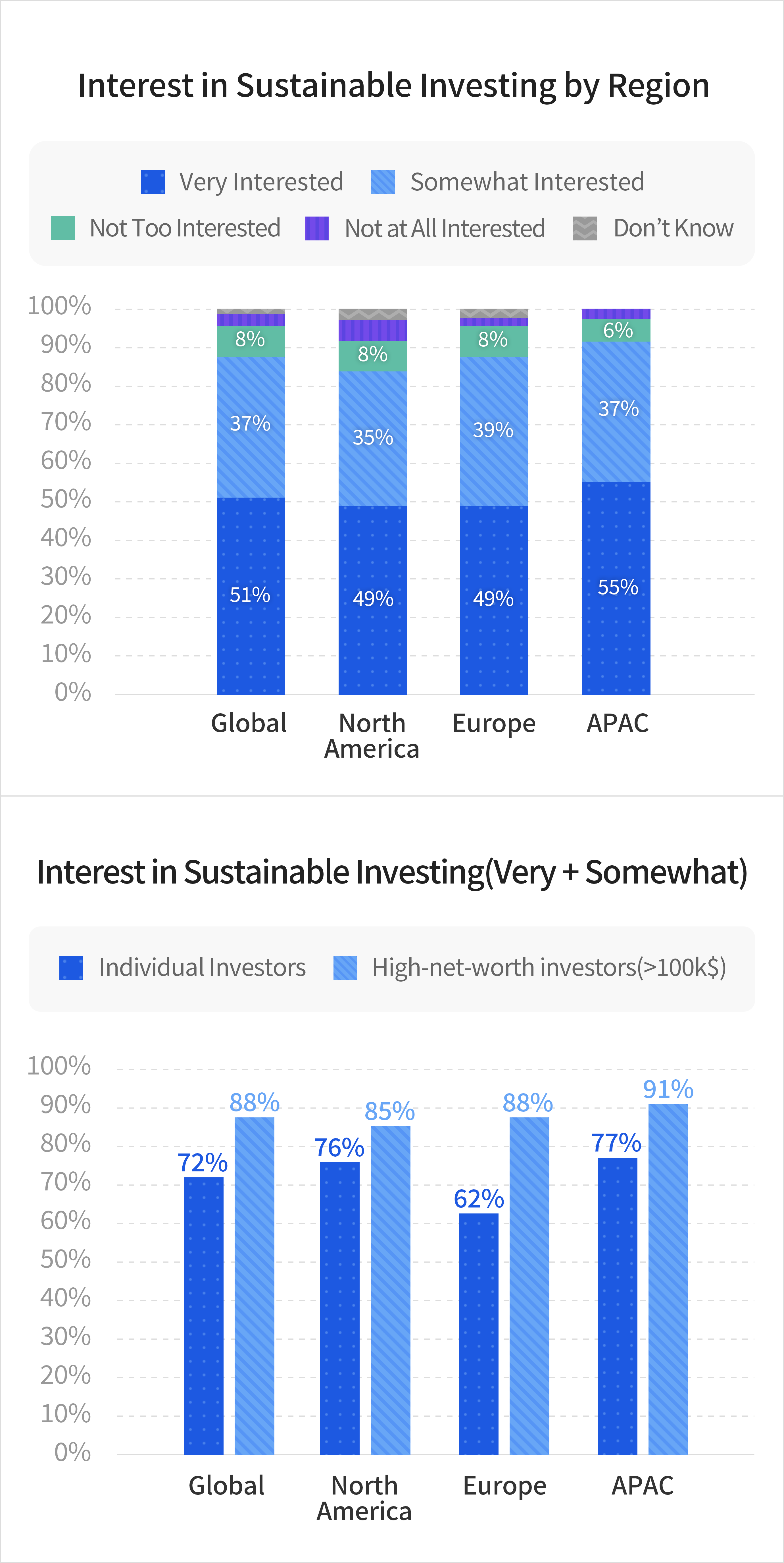
						Interest in Sustainable Investing by Region
						Global : Very Interested 51%, Somewhat Interested 37%, Not Too Interested 8%, Not at All Interested 4%, Don’t Know 1%
						North America : Very Interested 49%, Somewhat Interested 35%, Not Too Interested 8%, Not at All Interested 6%, Don’t Know 3%
						Europe : Very Interested 49%, Somewhat Interested 39%,Not Too Interested 8%, Not at All Interested 3%, Don’t Know 2%
						APAC : Very Interested 55%, Somewhat Interested 37%, Not Too Interested 6%, Not at All Interested 3%
						
						'Interest in Sustainable Investing(Very + Somewhat)'
						Global : Individual Investors 72%, High-net-worth investors(>100k$) 88%
						North America : Individual Investor 76%, High-net-worth investors(>100k$) 85%
						Europe : Individual Investor 62%, High-net-worth investors(>100k$) 88%
						APAC : Individual Investor 77%, High-net-worth investors(>100k$) 91% 
						Interest in Sustainable Investing by Region
						Global : Very Interested 51%, Somewhat Interested 37%, Not Too Interested 8%, Not at All Interested 4%, Don’t Know 1%
						North America : Very Interested 49%, Somewhat Interested 35%, Not Too Interested 8%, Not at All Interested 6%, Don’t Know 3%
						Europe : Very Interested 49%, Somewhat Interested 39%,Not Too Interested 8%, Not at All Interested 3%, Don’t Know 2%
						APAC : Very Interested 55%, Somewhat Interested 37%, Not Too Interested 6%, Not at All Interested 3%
						
						'Interest in Sustainable Investing(Very + Somewhat)'
						Global : Individual Investors 72%, High-net-worth investors(>100k$) 88%
						North America : Individual Investor 76%, High-net-worth investors(>100k$) 85%
						Europe : Individual Investor 62%, High-net-worth investors(>100k$) 88%
						APAC : Individual Investor 77%, High-net-worth investors(>100k$) 91% 
						Interest in Sustainable Investing by Region
						Global : Very Interested 51%, Somewhat Interested 37%, Not Too Interested 8%, Not at All Interested 4%, Don’t Know 1%
						North America : Very Interested 49%, Somewhat Interested 35%, Not Too Interested 8%, Not at All Interested 6%, Don’t Know 3%
						Europe : Very Interested 49%, Somewhat Interested 39%,Not Too Interested 8%, Not at All Interested 3%, Don’t Know 2%
						APAC : Very Interested 55%, Somewhat Interested 37%, Not Too Interested 6%, Not at All Interested 3%
						
						'Interest in Sustainable Investing(Very + Somewhat)'
						Global : Individual Investors 72%, High-net-worth investors(>100k$) 88%
						North America : Individual Investor 76%, High-net-worth investors(>100k$) 85%
						Europe : Individual Investor 62%, High-net-worth investors(>100k$) 88%
						APAC : Individual Investor 77%, High-net-worth investors(>100k$) 91%
Source: Morgan Stanley
Moreover, younger generations such as Millennials and Gen Z demonstrate significantly higher interest in sustainable investing than older generations, including Baby Boomers.
This suggests that as younger generations gain greater financial influence, sustainable investing is likely to become an increasingly important priority for investors.
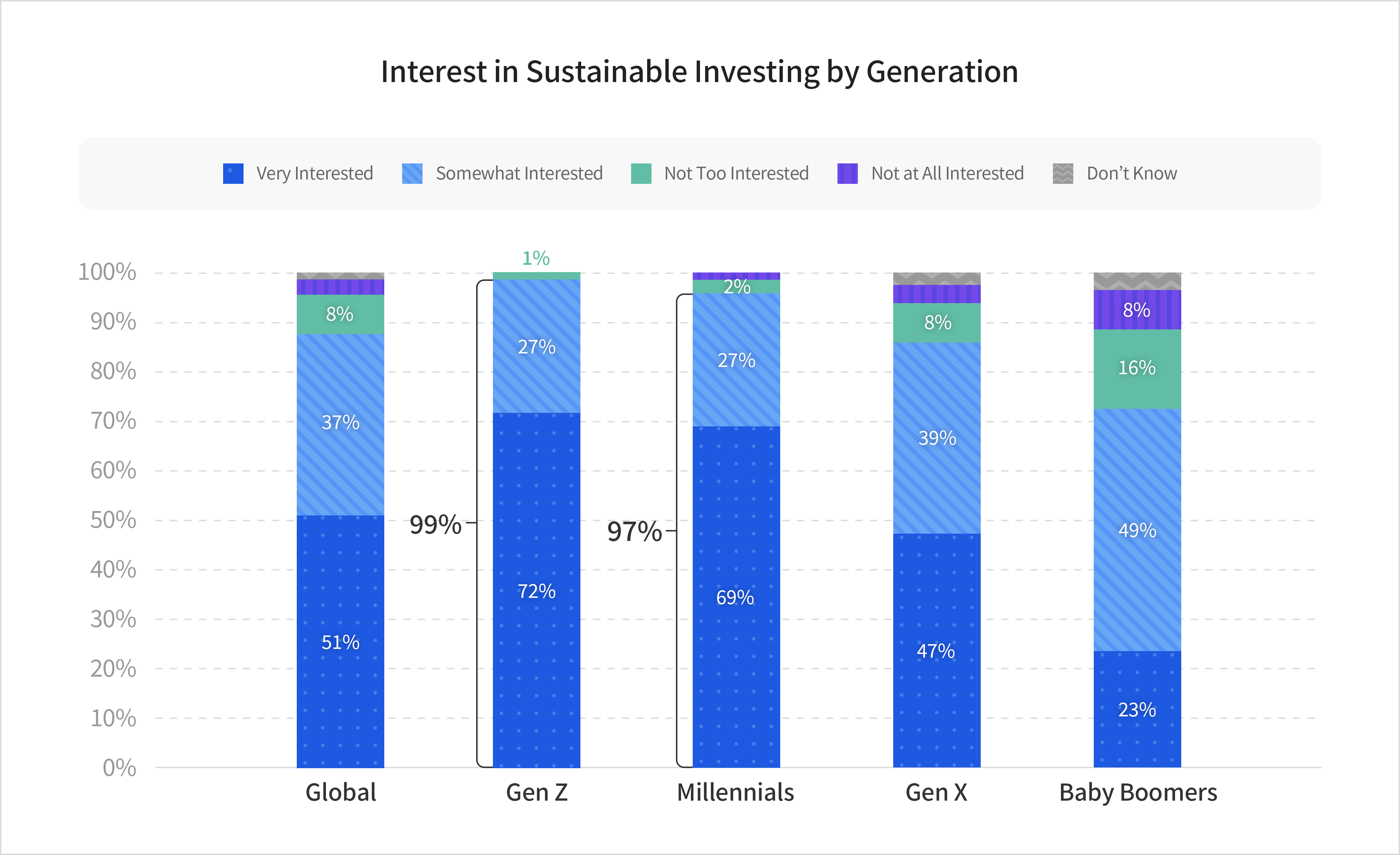
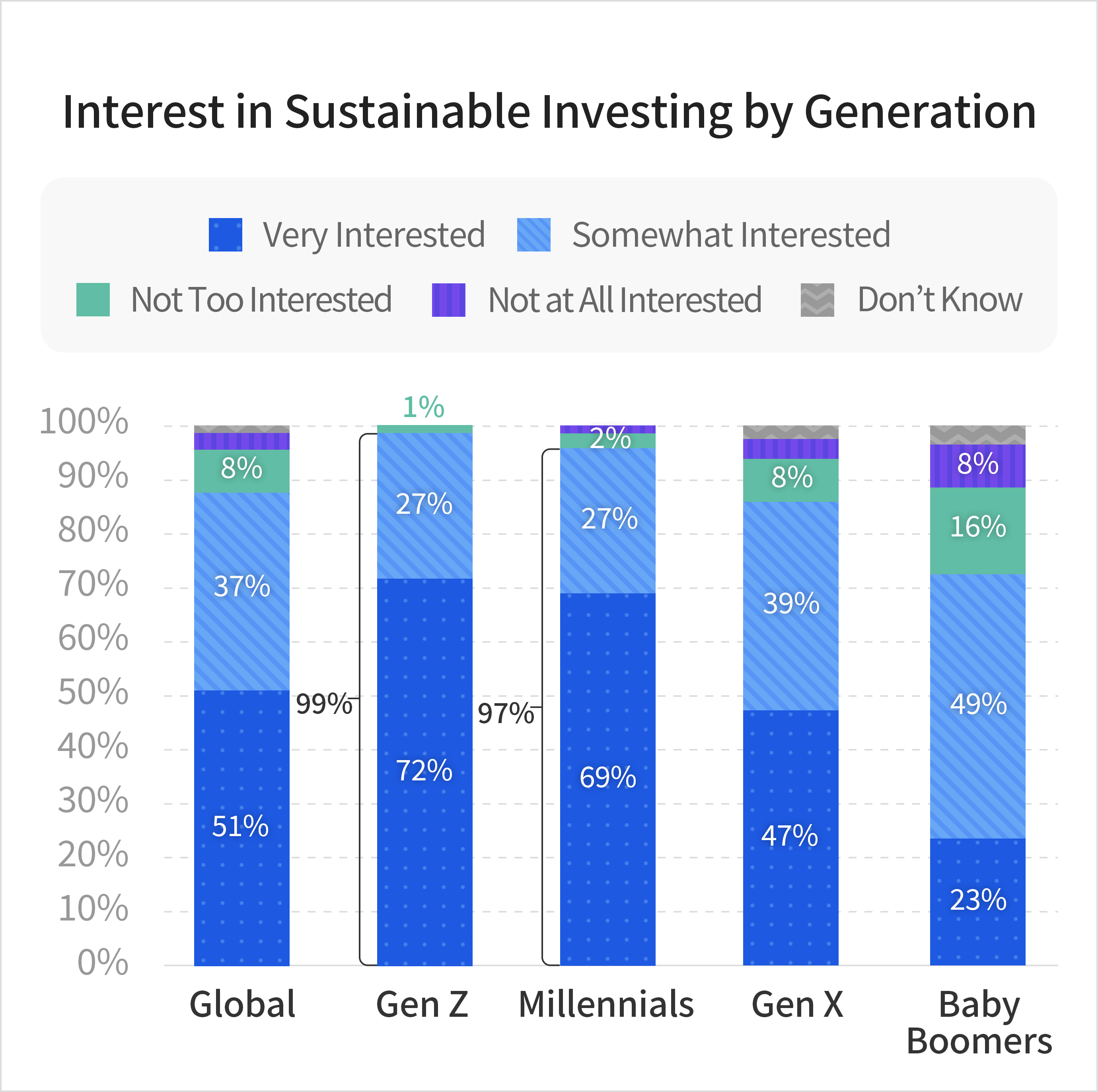
Interest in Sustainable Investing by Generation
							Global : Very Interested 51%, Somewhat Interested 37%, Not Too Interested 8%, Not at All Interested 3%, Don’t Know 1%
							Gen Z : Very Interested 72%, Somewhat Interested 27%,  Not Too Interested 1%
							Millennials : Very Interested 69%, Somewhat Interested 27%, Not Too Interested 2%, Not at All Interested 1%
							Gen X : Very Interested 47%, Somewhat Interested음 39%,  Not Too Interested 8%, Not at All Interested 4%, Don’t Know 2%
							Baby Boomers : Very Interested 23%, Somewhat Interested 49%,  Not Too Interested16%, Not at All Interested 8%, Don’t Know 4% Interest in Sustainable Investing by Generation
							Global : Very Interested 51%, Somewhat Interested 37%, Not Too Interested 8%, Not at All Interested 3%, Don’t Know 1%
							Gen Z : Very Interested 72%, Somewhat Interested 27%,  Not Too Interested 1%
							Millennials : Very Interested 69%, Somewhat Interested 27%, Not Too Interested 2%, Not at All Interested 1%
							Gen X : Very Interested 47%, Somewhat Interested음 39%,  Not Too Interested 8%, Not at All Interested 4%, Don’t Know 2%
							Baby Boomers : Very Interested 23%, Somewhat Interested 49%,  Not Too Interested16%, Not at All Interested 8%, Don’t Know 4% Interest in Sustainable Investing by Generation
							Global : Very Interested 51%, Somewhat Interested 37%, Not Too Interested 8%, Not at All Interested 3%, Don’t Know 1%
							Gen Z : Very Interested 72%, Somewhat Interested 27%,  Not Too Interested 1%
							Millennials : Very Interested 69%, Somewhat Interested 27%, Not Too Interested 2%, Not at All Interested 1%
							Gen X : Very Interested 47%, Somewhat Interested음 39%,  Not Too Interested 8%, Not at All Interested 4%, Don’t Know 2%
							Baby Boomers : Very Interested 23%, Somewhat Interested 49%,  Not Too Interested16%, Not at All Interested 8%, Don’t Know 4%
Source: Morgan Stanley
Introduction of the Stewardship Code
The Korean Stewardship Code, “Principles on the Stewardship Responsibilities of Institutional Investors” presents seven detailed principles and guidelines that institutional investors should implement to fulfill their fiduciary duties when managing assets entrusted by others and investing in domestic listed companies.
Institutional investors are expected to monitor investee companies, engage in dialogue when concerns arise, and exercise their shareholder rights responsibly in accordance with these principles.
Korean Stewardship Code
The Korean Stewardship Code sets forth the following seven principles as a soft law.
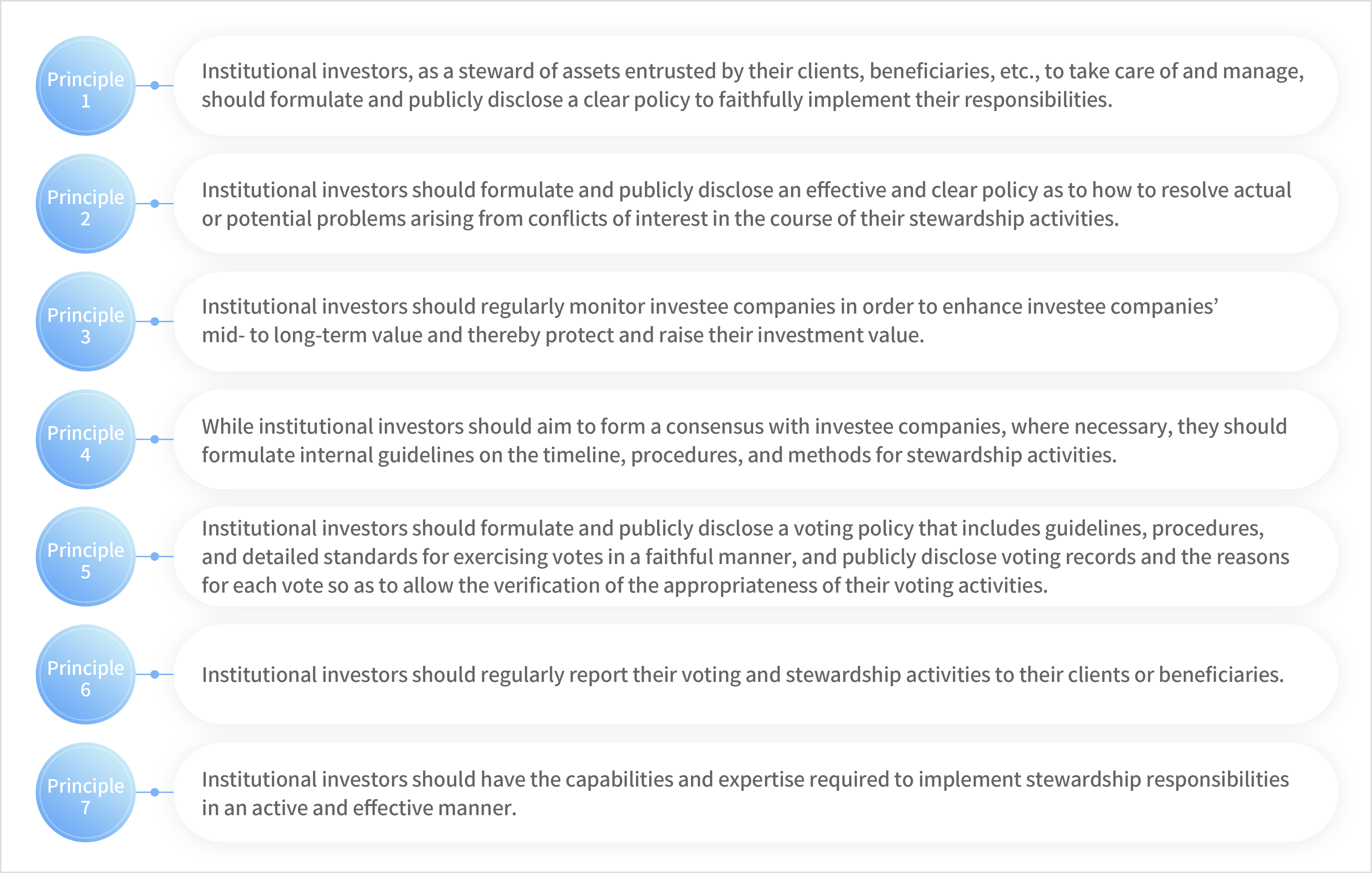
Principle 1 : Institutional investors, as a steward of assets entrusted by their clients, beneficiaries, etc., to take care of and manage, should formulate and publicly disclose a clear policy to faithfully implement their responsibilities.
						Principle 2 : Institutional investors should formulate and publicly disclose an effective and clear policy as to how to resolve actual or potential problems arising from conflicts of interest in the course of their stewardship activities.
						Principle 3 : Institutional investors should regularly monitor investee companies in order to enhance investee companies’ mid- to long-term value and thereby protect and raise their investment value.
						Principle 4 : While institutional investors should aim to form a consensus with investee companies, where necessary, they should formulate internal guidelines on the timeline, procedures, and methods for stewardship activities.
						Principle 5 :  Institutional investors should formulate and publicly disclose a voting policy that includes guidelines, procedures, and detailed standards for exercising votes in a faithful manner, and publicly disclose voting records and the reasons for each vote so as to allow the verification of the appropriateness of their voting activities.
						Principle 6 : Institutional investors should regularly report their voting and stewardship activities to their clients or beneficiaries.
						Principle 7 : Institutional investors should have the capabilities and expertise required to implement stewardship responsibilities in an active and effective manner. Principle 1 : Institutional investors, as a steward of assets entrusted by their clients, beneficiaries, etc., to take care of and manage, should formulate and publicly disclose a clear policy to faithfully implement their responsibilities.
						Principle 2 : Institutional investors should formulate and publicly disclose an effective and clear policy as to how to resolve actual or potential problems arising from conflicts of interest in the course of their stewardship activities.
						Principle 3 : Institutional investors should regularly monitor investee companies in order to enhance investee companies’ mid- to long-term value and thereby protect and raise their investment value.
						Principle 4 : While institutional investors should aim to form a consensus with investee companies, where necessary, they should formulate internal guidelines on the timeline, procedures, and methods for stewardship activities.
						Principle 5 :  Institutional investors should formulate and publicly disclose a voting policy that includes guidelines, procedures, and detailed standards for exercising votes in a faithful manner, and publicly disclose voting records and the reasons for each vote so as to allow the verification of the appropriateness of their voting activities.
						Principle 6 : Institutional investors should regularly report their voting and stewardship activities to their clients or beneficiaries.
						Principle 7 : Institutional investors should have the capabilities and expertise required to implement stewardship responsibilities in an active and effective manner. Principle 1 : Institutional investors, as a steward of assets entrusted by their clients, beneficiaries, etc., to take care of and manage, should formulate and publicly disclose a clear policy to faithfully implement their responsibilities.
						Principle 2 : Institutional investors should formulate and publicly disclose an effective and clear policy as to how to resolve actual or potential problems arising from conflicts of interest in the course of their stewardship activities.
						Principle 3 : Institutional investors should regularly monitor investee companies in order to enhance investee companies’ mid- to long-term value and thereby protect and raise their investment value.
						Principle 4 : While institutional investors should aim to form a consensus with investee companies, where necessary, they should formulate internal guidelines on the timeline, procedures, and methods for stewardship activities.
						Principle 5 :  Institutional investors should formulate and publicly disclose a voting policy that includes guidelines, procedures, and detailed standards for exercising votes in a faithful manner, and publicly disclose voting records and the reasons for each vote so as to allow the verification of the appropriateness of their voting activities.
						Principle 6 : Institutional investors should regularly report their voting and stewardship activities to their clients or beneficiaries.
						Principle 7 : Institutional investors should have the capabilities and expertise required to implement stewardship responsibilities in an active and effective manner.
Source: KCGS
From 2018 to 2020, institutional investors participating in the Code disclosed a total of 749 stewardship activities—123 in 2018, 286 in 2019, and 331 in 2020—demonstrating a consistent upward trend in stewardship engagement.
Shareholder Activities of Institutional Investors Participating in the Korean Stewardship Code (2018~2020) (Unit: cases)
						2018 : 123
						2019 : 286
						2020 : 331
						2018~2020 : 749 Shareholder Activities of Institutional Investors Participating in the Korean Stewardship Code (2018~2020) (Unit: cases)
						2018 : 123
						2019 : 286
						2020 : 331
						2018~2020 : 749 Shareholder Activities of Institutional Investors Participating in the Korean Stewardship Code (2018~2020) (Unit: cases)
						2018 : 123
						2019 : 286
						2020 : 331
						2018~2020 : 749
Source: KCGS Report(Sunmin Kim, 2021)
In addition, the proportion of domestic institutional investors voting against management has increased significantly since the introduction of the Code.
During regular shareholder meetings held between March 2014 and March 2016, private institutional investors voted against management in an average of 1.52% of cases. Following the adoption of the Code, the figure more than doubled to 3.32% between March 2017 and March 2020.
Trends in Voting Against Management by Domestic Private Institutional Investors (2014-2020)
Unit: %, Number of Companies
Category Before the Introduction of the Stewardship Code After the Introduction of the Stewardship Code
Mar
2014
Mar
2015
Mar
2016
Mar
2017
Mar
2018
Mar
2019
Mar
2020
Opposition Vote Ratio(%) 1.19 1.53 1.84 1.93 3.34 3.75 4.26
Number of Companies Voted On 490 604 636 661 719 710 761
Number of Institutional Investors 98 105 97 120 144 172 183

Note : Agenda items related to reporting, contested election, or shareholder proposal are excluded from the analysis.

Source: KCGS Report(Sunmin Kim, 2021)